
Scaling Fashion Retail OperationsWithout Losing Margin Control
72%
Reduction in manual commission and payout reconciliation workload
4.3x
Faster order-to-ledger posting across warehouse and partner-store sales
99%
Transaction traceability coverage across owner payouts, transfers, and advances
Growth exposed hidden operational friction
As store count and SKU complexity expanded, inventory movement, owner commission splits, and payout tracking became increasingly difficult to manage reliably through manual workflows. Teams were reconciling sales, shipment deductions, partner shares, and expenses across disconnected records, which created delays in decision-making and inconsistent settlement cycles.
A unified ERP layer built for commission-first retail
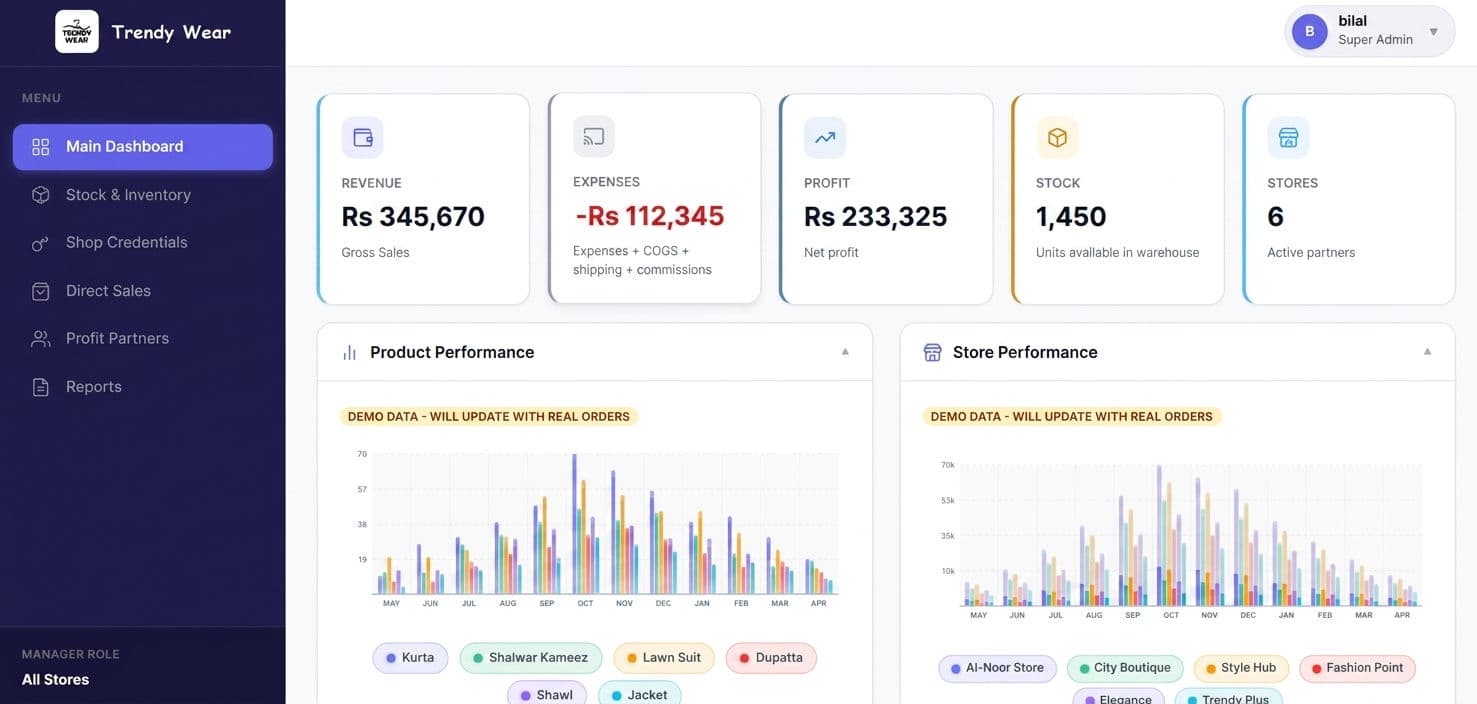
Neura Agency delivered a Next.js and Supabase architecture that combines a role-scoped admin dashboard with transactional APIs for inventory, orders, expenses, and owner settlements. Warehouse-to-store allocation, FIFO stock deduction, and commission math are executed server-side, ensuring consistency across every sale.
Core Capabilities
Role-Scoped Multi-Store Access Control
Custom session management maps users to super-admin, managed-admin, or store scopes. Every API response is filtered by allowed stores, ensuring each operator only sees the data they are authorized to manage.
Batch and Size-Aware Inventory Orchestration
Inventory is tracked by warehouse batch and supports size-level quantity logic during allocation and sales. The system validates stock availability before every movement and prevents over-allocation across partner stores.
Commission-Aware Sales Engine
Order posting automatically calculates amount received, commission amount, admin take, and net profit per transaction. FIFO deduction logic keeps warehouse and store stock synchronized with each sale.
Owner Settlement and Transfer Ledger
The platform records owner payouts, internal owner-to-owner transfers, and personal-account advances in a unified transaction model. This creates an auditable trail for settlement and balance reconciliation.
Integrated Financial Analytics and Reporting
Super-admin reporting surfaces revenue, COGS, expenses, margin, and store/product performance with interactive charts and print-ready PDF workflows. Teams can filter by weekly, monthly, or yearly periods for faster decisions.
Product Onboarding with Media Pipeline
New inventory entries can create products and upload item imagery directly to Supabase Storage. This keeps catalog data, visual assets, and stock records aligned from day one.
Architecture & Technology
Frontend
- Next.js 15
- React 18
- TypeScript
- Recharts
- Custom CSS Design System
Backend
- Next.js API Routes
- Supabase PostgreSQL
- @supabase/supabase-js
- bcryptjs
- Custom HttpOnly Cookie Session Layer
Infrastructure
- Supabase (PostgreSQL + Storage)
- Service-Role Secured Server Operations
- Vercel-Ready Deployment
External APIs
- Supabase Database API
- Supabase Storage API